The Enigmatic "Panda Dolphin": Unraveling the Mysteries of the Commerson’s Dolphin
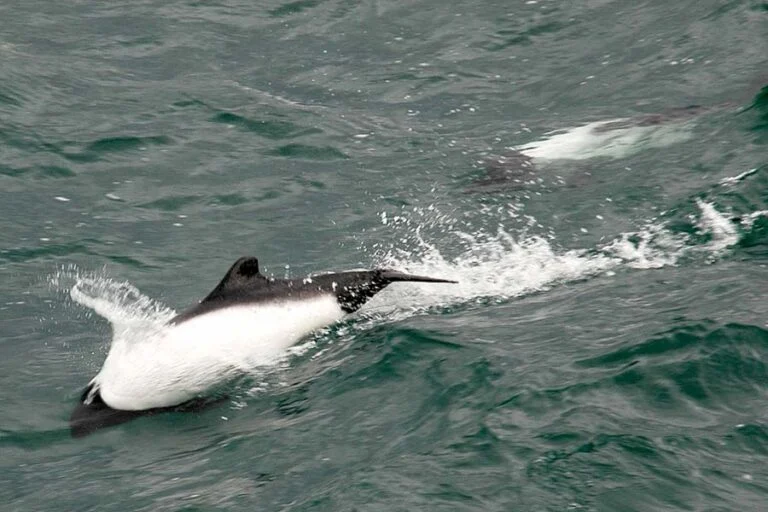
In the vast, churning waters off the coast of Patagonia, Argentina, a captivating spectacle recently unfolded, one that has sent waves of fascination across the digital landscape. A diminutive dolphin, sporting a striking black-and-white tuxedo pattern, was captured on film by documentary filmmaker Luis Burgueño. The footage shows the creature rolling playfully near a tourist vessel, its belly exposed to the surface as it maneuvers with agility through the Atlantic currents.
While many initial viewers mistook the animal for a miniature orca, it was, in fact, a Commerson’s dolphin (Cephalorhynchus commersonii), a species affectionately dubbed the "panda dolphin" due to its distinctive coloration. This viral encounter has reignited global interest in one of the ocean’s most elusive and charming marine mammals.
I. Main Facts: Meet the Panda of the Seas
The Commerson’s dolphin is a biological marvel, renowned not only for its striking aesthetic but also for its peculiar behavioral traits. Standing out from the typical grey-toned cetaceans, the Commerson’s dolphin boasts a crisp, high-contrast pattern: a black head and dorsal fin juxtaposed against a white torso.
Distinctive Features:
- Size: They are among the smallest cetaceans in the world. Their size, however, varies significantly by geography.
- Behavior: They are notorious for their acrobatic swimming, which often includes "porpoising" and a unique tendency to swim upside down.
- Taxonomy: There are two distinct populations—one in the South American coastal waters and a larger subspecies, Cephalorhynchus commersonii kerguelensis, found near the Kerguelen Islands in the southern Indian Ocean.
The viral video, which garnered millions of views on Instagram, captured the creature’s curiosity. For many, the sight of a marine mammal belly-up near a boat is interpreted as playfulness, but for marine biologists, it represents a complex interplay of survival, hunting, and intelligence.
II. Chronology of the Patagonian Encounter
The interaction, which took place in the waters of Patagonia, was not a fleeting, accidental occurrence. According to Luis Burgueño, the filmmaker who captured the footage, the encounter was a sustained interaction that lasted much longer than the edited clip suggests.
- The Approach: The dolphin, accompanied by others of its species, began approaching the vessel as it navigated the coastal waters.
- The Behavioral Shift: Unlike typical interactions where dolphins might bow-ride or jump, this individual specifically rolled over, exposing its underside.
- The Filming: Recognizing the uniqueness of the behavior, Burgueño began recording. He later noted his surprise at the animal’s lack of hesitation in showing its vulnerable underbelly to the ship.
- The Viral Aftermath: Upon uploading the footage to social media, the clip became an overnight sensation. It served as a bridge between professional marine biology and the public’s desire to connect with the natural world, prompting widespread discussion on the intelligence of small cetaceans.
III. Supporting Data: Geography, Biology, and Evolution
To understand the Commerson’s dolphin, one must look at the immense geographical chasm that separates its two primary populations. The South American group and the Kerguelen Island group are separated by approximately 8,500 kilometers of ocean.
The Divergence of Subspecies
The evolutionary trajectory of these two groups provides a fascinating case study in adaptation.
- The Kerguelen Giants: Living in the frigid, nutrient-rich waters near the Kerguelen Islands, these dolphins have evolved to be larger, reaching lengths of up to 1.8 meters and weighing as much as 86 kilograms.
- The Patagonian Compacts: In contrast, the South American population is smaller, typically weighing around 45 kilograms.
This size disparity suggests that the two groups have adapted to different environmental stressors, prey availability, and water temperatures, despite sharing a common ancestor.
The "Inverted" Swimming Mystery
Why do they swim upside down? While casual observers see playfulness, researchers have proposed several theories:

- Predatory Advantage: By swimming on its back, the dolphin may have a better angle to spot prey silhouetted against the lighter surface of the water.
- Camouflage: The black-and-white coloration, known as countershading, is a sophisticated form of camouflage. By rolling, the dolphin may be manipulating the light to break up its outline, making it harder for predators—or prey—to track its exact position.
IV. Official Perspectives and Scientific Interpretations
In an interview with the Daily Mail, Luis Burgueño offered his own interpretation of the behavior, suggesting it was a manifestation of "trust" or "confidence." However, the scientific community remains cautious about attributing human emotions to animal behavior.
The Expert View
Marine biologists emphasize that while the behavior looks like play, it is almost certainly tied to foraging. Dr. Maria Elena, a cetacean researcher familiar with the species, notes: "We often project our own desire for ‘play’ onto these animals. While they are undoubtedly intelligent and curious, every movement, especially in a hunting environment, serves a purpose. The upside-down orientation is a hallmark of their search for food, allowing them to scan the water column efficiently."
Furthermore, researchers point out that while they share a visual resemblance to the apex predator of the ocean—the orca—this does not imply a shared hunting strategy. The Commerson’s dolphin is a specialist, not a generalist, and its tactics are refined for the shallow coastal shelves it calls home.
V. Implications: Conservation and the Future of the Species
The fame of the "panda dolphin" brings both benefits and challenges. While public awareness can drive conservation funding, it can also lead to increased pressure from tourism.
The Role of Captivity
The species is represented in several international aquariums, most notably the Sendai Umino-Mori Aquarium in Japan. These facilities have provided invaluable data on the reproductive cycles and lifespans of the dolphins—information that is notoriously difficult to collect in the wild. However, activists argue that captivity is a poor substitute for the vast, complex ecosystem of the Patagonia coast.
The "Data Gap"
The most pressing implication of the viral fame of these animals is the realization of how little we actually know. Data regarding the global population of Cephalorhynchus commersonii remains fragmented. Because they frequent shallow, sometimes turbulent waters, traditional aerial surveys are difficult.
Toward a Sustainable Future
The viral footage serves as a call to action. If the world is to protect these "pandas of the sea," we must move beyond the "cute" factor. Implications for the future include:
- Strict Tourism Regulation: Ensuring that boats interacting with these pods maintain a distance that does not disrupt hunting or social rituals.
- Expanded Research: Funding non-invasive acoustic and satellite tracking to map their movements more accurately.
- Habitat Protection: Recognizing that the coastal regions they inhabit are often under threat from commercial fishing and shipping lanes.
As the video of the small, black-and-white dolphin continues to circulate, it stands as a reminder of the ocean’s hidden complexity. The Commerson’s dolphin is not merely a "cute" curiosity; it is a highly adapted survivor, a navigator of the Southern Hemisphere’s currents, and a species that requires our protection as much as it demands our admiration. Whether they are truly playing or simply hunting in their own unique, inverted way, these dolphins continue to challenge our understanding of marine life, one roll at a time.