Indonesia’s Cultural Diplomacy Shines at the 2026 Festival Bambuco: A Bridge Across Continents
Introduction: A Tropical Symphony in Colombia
In a vibrant display of cultural diplomacy that bridged the thousands of miles between Southeast Asia and South America, the Republic of Indonesia took center stage at the prestigious Festival Bambuco 2026 in Neiva, Colombia. As the sole international participant, Indonesia captivated thousands of spectators, showcasing the rich tapestry of the Indonesian archipelago through the lens of Kalimantan’s unique biodiversity and cultural heritage.
The participation, led by the Embassy of the Republic of Indonesia (KBRI) in Bogota, served as more than just a performance; it was a strategic initiative to foster closer ties between the two nations, proving that despite geographical distances, the shared spirit of cultural richness offers a fertile ground for future cooperation.
Main Facts: The Kalimantan Showcase
The Indonesian delegation’s presence at the festival was marked by a centerpiece display: an ornate, symbolic float featuring the majestic Hornbill (Burung Enggang). The choice of the Hornbill was calculated and poetic. As reported by the KBRI Bogota on July 3, 2026, the bird served as an immediate point of connection for the Colombian audience. While the Hornbill and the native Colombian Toucan belong to different biological families, their visual strikingness and cultural significance in their respective regions sparked instant fascination among the local public.
This year’s participation was unique, as Indonesia was granted the honor of Pais Invitado (Guest Country) by the Governor of Huila Province. This status elevated Indonesia’s role from mere observer to a central pillar of the festival, highlighting the growing bilateral relationship between Jakarta and Bogota.
Chronology of the Festive Journey
The journey to the heart of Huila was characterized by meticulous preparation and enthusiastic public engagement.
The Carnival Parade
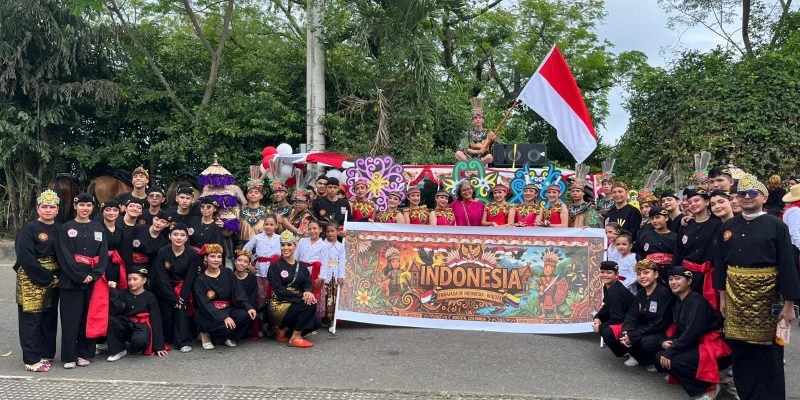
The highlight of the participation was the three-kilometer carnival route through the streets of Neiva. The Indonesian contingent was a sea of color, consisting of 15 professional artists from the KBRI Bogota and a heart-warming group of approximately 50 local Colombian children. These children, dressed in traditional Indonesian kebaya and pencak silat uniforms, marched alongside the performers, creating a powerful visual metaphor for cultural integration.
The air was filled with the rhythmic beats of Indonesia’s most beloved folk songs, including Sajojo, Poco-Poco, Tabola Bale, Goyang Tobelo, and Tamang Pung Kisah. The choreography, which blended traditional movements with the infectious energy of these songs, drew roaring applause from the Colombian crowds.
.jpg)
The Diplomatic Presence
The procession was led by the Indonesian Ambassador to Colombia, Tatang Budie Utama Razak. Breaking the formalities of traditional diplomacy, Ambassador Razak joined the dancers, engaging in the Poco-Poco and other traditional dances. His participation served to dismantle the barrier between the diplomatic corps and the public, creating an atmosphere of shared joy and mutual respect that defined the day’s proceedings.
Beyond the Parade: The Cultural Tour
The festival did not end with the parade. The KBRI Bogota artistic team continued their mission, performing on various national and international cultural stages throughout Neiva. These performances were designed to provide a comprehensive view of Indonesia’s tourism potential, emphasizing the "Wonderful Indonesia" brand to a South American audience that is increasingly interested in Southeast Asian destinations.
Supporting Data: Why Kalimantan?
The selection of Kalimantan—the Indonesian portion of the island of Borneo—as the overarching theme was a strategic decision by the KBRI. Kalimantan is synonymous with Indonesia’s "green lung," housing one of the world’s most critical rainforests and a vast array of endemic flora and fauna.
By highlighting Kalimantan, the KBRI aimed to:
- Promote Biodiversity Awareness: By comparing the Hornbill to the Toucan, the delegation opened a dialogue on global conservation efforts and the shared responsibility of preserving tropical ecosystems.
- Display Cultural Diversity: Kalimantan’s indigenous Dayak cultures offer a unique aesthetic—characterized by intricate beadwork, wood carving, and ceremonial dances—that stands out distinctly from the Javanese or Balinese cultural exports more commonly seen abroad.
- Economic Tourism Potential: The exhibition served as a soft-power marketing tool, encouraging Colombian travelers to look toward Indonesia as a destination for eco-tourism and cultural exploration.
Official Responses: Strengthening the Bilateral Ties
The diplomatic impact of the event was solidified during the visit to Neiva, where Ambassador Tatang Budie Utama Razak underscored the importance of the mission.
"Besides showcasing our rich culture, we wanted to demonstrate that although Indonesia and Colombia are separated by a vast geographical distance, our nations share a profound number of similarities," Ambassador Razak stated. He noted that the enthusiasm of the Colombian people proves that there is a deep curiosity about Indonesia, which can be leveraged into concrete collaboration. "There is much to be explored further, particularly through cooperation in various strategic fields."
The Ambassador’s sentiment was echoed by local officials in Huila, who welcomed the Indonesian delegation with open arms. The integration of 50 local children into the Indonesian performance was particularly lauded as a "gesture of friendship that will be remembered by the youth of Neiva for years to come."

Implications: The Path Toward Future Cooperation
The participation in the Festival Bambuco was not merely a cultural event; it was a stepping stone for institutionalized cooperation. In a significant move to formalize these new bonds, Ambassador Razak utilized the trip to sign two major Memorandums of Understanding (MoU).
Educational and Cultural Agreements
The agreements were signed between the KBRI Bogota and two key academic institutions:
- Universidad Nacional Abierta y a Distancia (UNAD) – Southern Zone: This agreement aims to facilitate academic exchanges, research partnerships, and the promotion of the Indonesian language (Bahasa Indonesia) among Colombian students.
- The University Network of Huila Province: This partnership is designed to foster a long-term exchange program between Indonesian universities and the provincial universities of Huila, focusing on sustainable development, tropical agriculture, and cultural anthropology.
Long-term Diplomatic Gains
The implications of these agreements are far-reaching. By embedding Indonesian culture into the educational fabric of Huila, the KBRI is building a foundation of "people-to-people" diplomacy. This ensures that the relationship between Indonesia and Colombia is not dependent solely on political cycles but is rooted in academic and social networks.
Furthermore, the status of Pais Invitado provides Indonesia with a template for future engagements in South America. The success of the "Kalimantan Theme" demonstrates that specific, thematic representations of Indonesian regions are more effective at capturing the imagination of international audiences than generic portrayals of the country.
Conclusion: A Shared Future
As the curtain closed on the 2026 Festival Bambuco, the impact of Indonesia’s presence remained palpable in Neiva. The sight of local children dancing to the tunes of Poco-Poco alongside Indonesian diplomats is a testament to the power of cultural diplomacy.
Indonesia’s successful outing in Colombia serves as a blueprint for middle-power diplomacy. By focusing on shared values—biodiversity, youth empowerment, and cultural pride—Indonesia has successfully positioned itself as a relevant and dynamic partner for Colombia. As the KBRI Bogota continues to implement the newly signed educational agreements, the "Hornbill and the Toucan" will be remembered not just as a visual curiosity of a parade, but as the symbol of a new era of friendship between two nations separated by oceans, yet united by a common rhythm of life.
Reported by the Indonesian Embassy in Bogota. This coverage reflects the spirit of cultural diplomacy initiatives conducted in July 2026.