Danantara Forges Strategic Alliance with Tony Blair Institute to Accelerate Indonesia’s State-Owned Enterprise Transformation
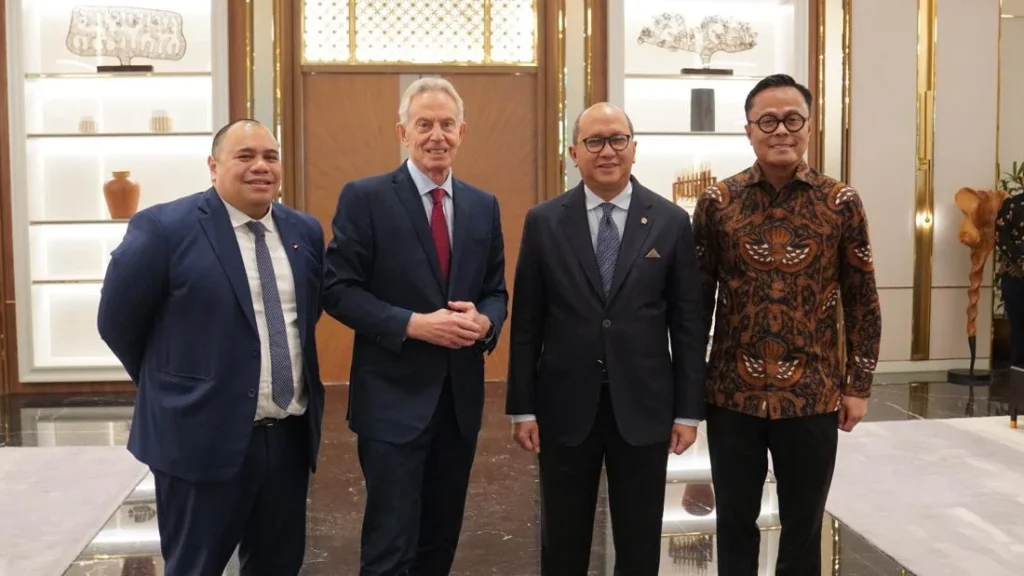
JAKARTA – In a move signaling Indonesia’s aggressive pursuit of global economic integration and institutional reform, the newly formed investment management entity, Badan Pengelola Investasi (BPI) Danantara, has officially entered into high-level strategic discussions with the Tony Blair Institute for Global Change (TBI). The meeting, held in Jakarta, marks a pivotal moment for the nation’s state-owned enterprises (SOEs) as they seek to transition from domestic players to global-standard industry leaders.
The delegation, led by former British Prime Minister Tony Blair, engaged with the top brass of Danantara, including CEO and Minister of Investment and Downstream Industry Rosan Roeslani, COO and Head of the State-Owned Enterprises Agency (BP BUMN) Dony Oskaria, and CIO Pandu Sjahrir. The high-stakes summit centered on a comprehensive roadmap for systemic transformation, investment scaling, and long-term national development.
1. Main Facts: The Intersection of Policy and Global Capital
At the core of the meeting was the alignment of Danantara’s mission—to serve as a sovereign investment hub—with TBI’s expertise in governance reform and global policy implementation. Danantara, which acts as the umbrella organization managing Indonesia’s vast state-owned assets, is currently under intense pressure to optimize performance, improve governance, and maximize dividends for the state treasury.
The collaboration focuses on four strategic pillars:
- Institutional Governance: Implementing international best practices to streamline SOE decision-making processes.
- Downstream Industry Acceleration: Leveraging global networks to secure technology transfers and capital for Indonesia’s burgeoning mineral and industrial downstream sectors.
- Strategic Infrastructure & Digital Transformation: Utilizing the TBI’s global advisory expertise to modernize Indonesia’s infrastructure and digital ecosystem.
- Competitive Positioning: Enhancing the attractiveness of Indonesian assets to international institutional investors.
By inviting the Tony Blair Institute into the fold, Danantara is signaling to the global market that Indonesia is committed to a transparent, efficient, and investor-friendly environment for its state-run industries.
2. Chronology of the Strategic Engagement
The path toward this collaboration did not happen in isolation. The Indonesian government, under the administration of President Prabowo Subianto, has been actively seeking external expertise to refine its national investment vehicle.
- Formation of Danantara: The establishment of BPI Danantara represented a fundamental shift in how the government handles its equity in major state companies. By centralizing management, the government sought to move away from fragmented oversight toward a more unified investment approach.
- Initial Outreach: Discussions between TBI and Indonesian government officials began in early 2026, as the government sought to address bottlenecks in the SOE sector that were hindering rapid growth.
- The Jakarta Summit: On July 7, 2026, the formal meeting took place. Tony Blair’s presence underscored the high level of priority given to this partnership. The session lasted for several hours, with deep-dive technical discussions on how TBI’s experience in emerging market transformations could be synthesized with Indonesia’s unique socio-economic landscape.
- Strategic Roadmap Development: Following the meeting, the teams from Danantara and TBI have been tasked with identifying "quick-win" projects, specifically in the energy and digital infrastructure sectors, which are expected to be unveiled in the final quarter of the year.
3. Supporting Data and Economic Context
Indonesia’s SOE sector is among the largest in the world, contributing significantly to the national GDP. However, inefficiencies—ranging from bureaucratic overlaps to high debt-to-equity ratios—have long been a concern for international rating agencies.
- Scale of Assets: Danantara manages a portfolio of assets estimated to be in the hundreds of billions of dollars, covering industries from banking and telecommunications to mining and transportation.
- Foreign Direct Investment (FDI) Trends: Recent data from the Ministry of Investment indicates a consistent uptick in FDI, but the government aims to pivot from raw commodity exports to value-added manufacturing. The collaboration with TBI is designed to bridge the gap between Indonesian policy and the requirements of global capital markets.
- Efficiency Metrics: Comparative data presented during the summit suggests that by optimizing operational costs and digitalizing supply chains, select Indonesian SOEs could improve their EBITDA margins by an estimated 15–20% over the next three years.
The involvement of the Tony Blair Institute, which has advised governments across Africa, the Middle East, and Asia, provides a layer of credibility that is essential for attracting global pension funds and sovereign wealth funds to invest in Indonesia’s downstream projects.
4. Official Responses: A Vision for the Future
The leadership at Danantara expressed a strong sense of urgency regarding the transformation of the state sector.
Dony Oskaria, COO of Danantara and Head of BP BUMN, emphasized that while Indonesia has the raw potential, it requires the "global institutional architecture" to reach its peak. "We want to accelerate the transformation of our SOEs. It is imperative that we open our doors to global partners like the Tony Blair Institute," Oskaria stated during the post-meeting press conference.
"We are not merely looking for capital; we are looking for knowledge transfer. Many of the challenges we face in state-owned management are not unique to Indonesia. By adapting the best practices curated by the TBI, we can ensure that our SOEs become professional, globally competitive, and, most importantly, catalysts for sustainable national economic growth," he added.
Pandu Sjahrir, CIO of Danantara, echoed these sentiments, noting that the collaboration is not just about structure, but about "mindset." According to Sjahrir, the shift toward a more investment-oriented culture within these companies is the only way to ensure their longevity in a volatile global economy.
5. Implications: What This Means for Indonesia’s Global Standing
The partnership with the Tony Blair Institute is more than a policy exercise; it is a geopolitical statement. By aligning with a high-profile international institution, Indonesia is effectively "de-risking" its state-owned enterprises in the eyes of the international community.
A. Improved Investor Confidence
For global institutional investors, the primary barrier to entry in Indonesia has often been a lack of transparency and regulatory consistency. If the Danantara-TBI collaboration results in clearer, more standardized governance frameworks, it could lead to a massive influx of foreign capital into Indonesian state-led projects.
B. Accelerated Downstream Industrialization
The "Hilirisasi" (downstream) program is the cornerstone of Indonesia’s economic strategy. By leveraging the TBI’s network, Danantara aims to attract partners who can provide not just cash, but the advanced technology required for high-tech manufacturing—moving beyond the export of raw nickel or copper and into the production of high-value goods like electric vehicle batteries and renewable energy components.
C. Institutional Resilience
By modernizing the institutional capacity of BP BUMN, the government is insulating the sector against political cycles. A more professionalized and merit-based management structure ensures that state assets are insulated from short-term political pressures, allowing for long-term strategic planning that spans multiple administrations.
D. Digital and Infrastructure Synergy
TBI’s experience in digital governance is expected to play a critical role in the digital transformation of Indonesian state companies. As Indonesia seeks to build a "Smart Nation," the integration of data-driven decision-making across the SOE portfolio will be paramount.
Conclusion: A New Era for Indonesian Enterprise
As the meeting concluded, the atmosphere was one of measured optimism. The collaboration between BPI Danantara and the Tony Blair Institute is a clear indicator that Indonesia is moving toward a more sophisticated model of state capitalism.
While the road ahead—filled with structural reforms and the necessity of navigating a complex global economy—remains challenging, the alignment of vision between Danantara’s leadership and global advisory experts suggests a robust path forward. If successfully implemented, this partnership could well be the catalyst that transforms Indonesia’s state-owned enterprises from domestic assets into global champions, firmly anchoring the nation as a premier destination for high-quality, sustainable, and long-term global investment.
As the government continues to refine these partnerships, all eyes will be on the concrete outcomes of this engagement—specifically, the speed at which these "best practices" are translated into tangible policy changes and the subsequent reaction from the international financial markets. For Indonesia, the message is clear: the country is not just open for business; it is ready to compete at the highest level of the global stage.