Google Ignites 2026 FIFA World Cup Fever with "Mini Cup" Mobile Game: A Deep Dive into the Gamification of Search
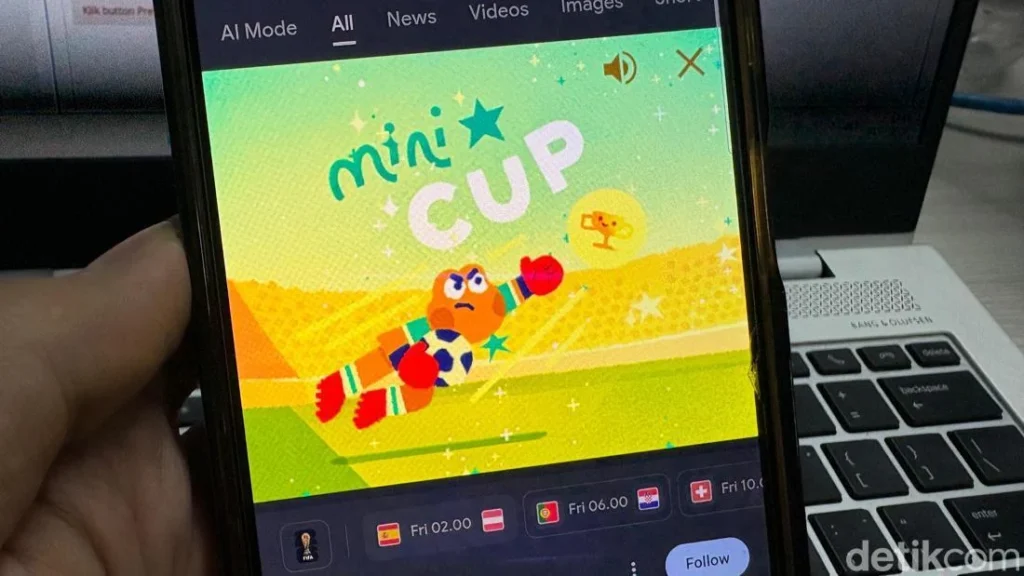
JAKARTA – As the global sporting community begins its countdown to the 2026 FIFA World Cup, tech giant Google has officially launched "Mini Cup," a hyper-casual mobile game integrated directly into its search engine. Designed to capture the excitement of the upcoming tournament, the game offers a deceptively simple penalty shootout experience that has quickly become a viral sensation. While the game appears easy at first glance, its escalating difficulty and global leaderboard mechanics have turned a simple search query into a competitive digital arena.
The 2026 FIFA World Cup, set to be hosted across Canada, Mexico, and the United States, represents a milestone in sporting history as the first edition to feature 48 teams. Google’s "Mini Cup" serves as a digital precursor to this massive event, leveraging the company’s massive reach to engage fans through gamification.
I. Main Facts: The Deceptive Simplicity of Mini Cup
At its core, Google’s Mini Cup is a penalty shootout simulator. Unlike traditional football video games like the EA Sports FC series (formerly FIFA) or eFootball, Mini Cup does not feature 11-on-11 matches, complex tactical formations, or intricate button combinations. Instead, it focuses on the most high-stakes moment in football: the duel between the striker and the goalkeeper.
Key Features and Accessibility
The game is accessible via the Google app or mobile browser by searching for "World Cup" or "FIFA World Cup." However, a critical distinction noted by early users is its platform exclusivity. Currently, Mini Cup is optimized strictly for mobile devices (iOS and Android). Users attempting to access the game via desktop or laptop computers will find the feature absent, reflecting Google’s "mobile-first" strategy in capturing the attention of users on the go.
The Difficulty Curve
Initial tests conducted by detikINET and other tech enthusiasts reveal that the game employs a sophisticated difficulty algorithm.
- The Grace Period (0-10 Goals): In the early stages, the goalkeeper moves at a predictable, slow pace. This allows players to get accustomed to the swipe-to-shoot mechanics.
- The First Threshold (10-25 Goals): Once a player surpasses 10 goals, the goalkeeper’s AI becomes noticeably more aggressive. Reaction times are shortened, and the speed of lateral movement increases.
- The Elite Tier (25+ Goals): Beyond 25 goals, the game enters a "hard mode" state. The goalkeeper reacts almost instantaneously to the trajectory of the ball, requiring the player to utilize extreme precision and varying speeds in their swipes.
Failure occurs the moment the ball hits the post, goes out of bounds, or is caught by the goalkeeper. This "one-strike" policy adds a layer of tension that mirrors the real-life pressure of a World Cup penalty shootout.
II. Chronology: From Easter Eggs to Global Tournaments
Google has a long-standing history of integrating "Easter eggs" and interactive Doodles into its search results. The evolution of Mini Cup can be traced back through several key technological milestones.
The Evolution of Google Search Games
For over a decade, Google has experimented with interactivity. It began with simple "Doodles" to commemorate holidays, such as the famous Pac-Man Doodle in 2010. Over time, these evolved into more complex experiences, such as the Great Ghoul Duel or the Doodle Champion Island Games released during the Tokyo 2020 Olympics.
The 2022 Precedent
The concept of the Mini Cup was first introduced during the Qatar 2022 World Cup. It was an experimental feature designed to see if users would engage with a collective scoring system. The experiment was a resounding success, with billions of goals scored globally within the month of the tournament.
The 2026 Re-launch
With the 2026 World Cup on the horizon, Google has brought back the Mini Cup with refined graphics and a more robust server infrastructure to handle the anticipated surge in traffic. The current iteration serves as a permanent or semi-permanent fixture in the search results as the qualifiers for 2026 progress, ensuring that the "football fever" remains constant throughout the four-year cycle.
III. Supporting Data: Global Competition and National Pride
One of the most compelling aspects of Mini Cup is its integration of real-world data and collective participation. The game is not just an individual pursuit; it is a global competition where every goal scored contributes to a nation’s total.
The Global Leaderboard
As of the latest reports, the leaderboard shows a fierce competition between traditional football powerhouses. Currently, Brazil holds the top spot, a testament to the country’s massive population and its deep-rooted passion for the sport. Other nations frequently appearing in the top five include Argentina, Mexico, and Indonesia, the latter showcasing the immense mobile-gaming demographic in Southeast Asia.
User Statistics and Persistence
Google provides players with a comprehensive dashboard within the game interface. This includes:
- Total Games Played: Tracking the user’s persistence.
- Total Goals Scored: A cumulative tally of their contribution to their country.
- Achievements/Awards: Digital badges earned for reaching specific milestones (e.g., scoring 50 goals in a single session).
Technological Infrastructure
The game is built using lightweight web technologies (HTML5 and JavaScript), ensuring it can run on a wide variety of mobile hardware, from high-end flagship devices to budget-friendly smartphones in emerging markets. This inclusivity is key to its high engagement numbers.
IV. Official Context: FIFA and the 2026 Vision
While Google operates the Mini Cup independently as a search feature, it aligns with the broader objectives of FIFA and the 2026 host nations.
Expanding the Fanbase
FIFA has publicly stated its goal for the 2026 World Cup: to make it the most inclusive and expansive sporting event in history. By expanding the tournament to 48 teams, FIFA is targeting markets that previously had little chance of qualification. Google’s Mini Cup supports this by allowing fans from any country—regardless of whether their national team qualified—to participate in the digital version of the tournament.
The Role of Gamification in Sports
Industry analysts suggest that "snackable" gaming experiences like Mini Cup are essential for capturing the Gen Z and Gen Alpha demographics. These younger audiences often consume sports through highlights and interactive content rather than traditional 90-minute broadcasts. Google’s initiative acts as a bridge, keeping the World Cup brand relevant in the daily digital lives of these younger fans.
V. Implications: The Future of Search and Digital Engagement
The launch and success of Mini Cup have significant implications for the future of the internet, digital marketing, and how we interact with information.
1. Search Engines as Entertainment Hubs
Google is no longer just a place to find links; it is becoming a destination in itself. By hosting games like Mini Cup, Google increases the "dwell time" (the amount of time a user spends on a page). This shift from a "search engine" to an "experience engine" represents a fundamental change in Google’s business model, aiming to keep users within their ecosystem for as long as possible.
2. The Rise of Hyper-Casual Gaming
Mini Cup’s success highlights the power of hyper-casual games. These games require no tutorial, have very short play sessions, and offer instant gratification. In an era of shrinking attention spans, the ability to play a quick 30-second penalty shootout while waiting for a bus or during a lunch break is highly appealing.
3. National Identity in the Digital Age
The leaderboard mechanics of Mini Cup tap into the same psychology as the World Cup itself: national pride. By allowing users to "play for their country," Google has created a low-stakes way for people to express their identity. This collective effort creates a sense of community among strangers who are all swiping their screens to push their nation to the top of the rankings.
4. SEO and Brand Awareness
For businesses and marketers, the Mini Cup phenomenon demonstrates the importance of "Event-Based SEO." When millions of people search for "World Cup," Google’s own internal features (like the game) will always take precedence. This forces brands to rethink how they compete for visibility during major global events when the platform owner is providing its own immersive content.
5. Technical Limitations as a Feature
By keeping the game mobile-exclusive, Google acknowledges the reality of modern internet usage. Over 60% of global web traffic now comes from mobile devices. By not offering a desktop version, Google ensures a uniform user experience centered around touch-screen mechanics, which are more intuitive for a penalty shootout game than a mouse and keyboard.
Conclusion: A New Era of Fandom
Google’s Mini Cup is more than just a simple distraction; it is a sophisticated engagement tool that leverages the world’s most popular sport to test the limits of search engine capability. As the road to the 2026 FIFA World Cup continues, expect Mini Cup to evolve, perhaps adding new features, real-time updates based on qualifier results, and even more challenging AI.
For now, the challenge remains: can you beat the goalkeeper after 25 goals? As the global leaderboard continues to shift, one thing is certain—the battle for digital football supremacy is just as intense as the one that will take place on the pitches of North America in 2026. Whether you are a casual fan or a hardcore gamer, Mini Cup offers a glimpse into a future where the line between searching for information and playing a game is permanently blurred.