President Prabowo Subianto Formally Inaugurates 204 New TNI Units to Bolster National Defense Architecture on 81st Armed Forces Anniversary
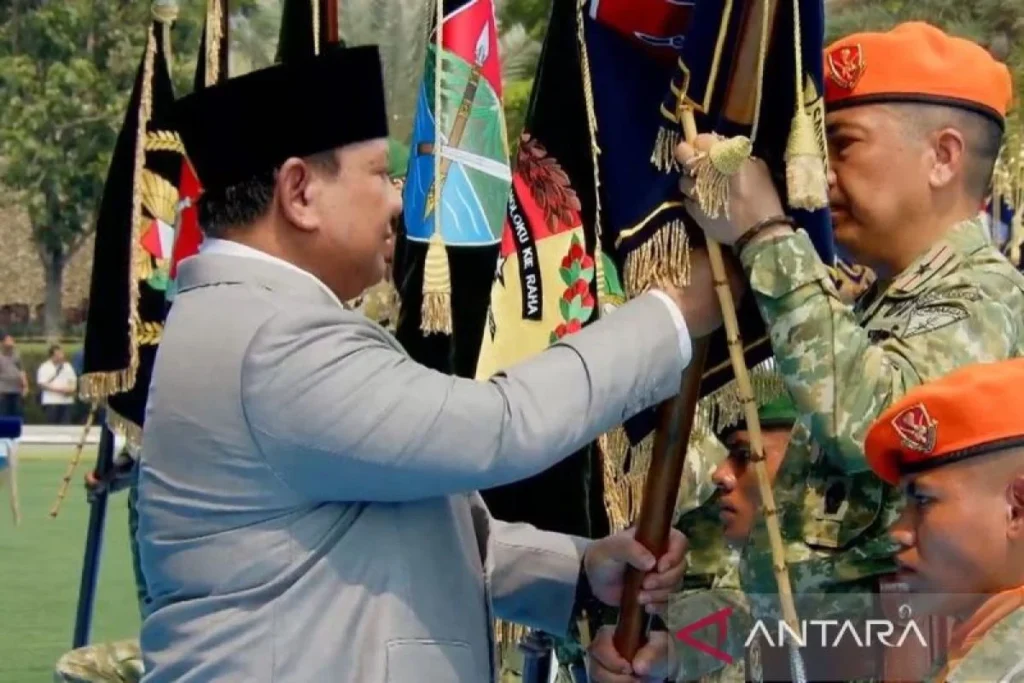
JAKARTA — In a landmark move aimed at restructuring and significantly scaling up Indonesia’s military defense capabilities, President Prabowo Subianto officially inaugurated 204 new units across the Indonesian National Armed Forces (TNI). The historic inauguration took place during the grand ceremonial parade commemorating the 81st Anniversary of the TNI at the PRIMA Field, TNI Headquarters in Cilangkap, East Jakarta, on Monday, October 5, 2026.
The sweeping structural expansion encompasses all three branches of the military—the Indonesian Army (TNI AD), the Indonesian Navy (TNI AL), and the Indonesian Air Force (TNI AU). This strategic initiative represents one of the most comprehensive military organizational overhauls in recent history, designed to meet modern geopolitical challenges, secure sprawling archipelagic borders, and enhance territorial readiness.
Standing before thousands of troops, state officials, and citizens, President Prabowo underscored the gravity of the expansion.
"With the utterance of bismillahirrahmanirrahim, on this Monday morning, October 5, 2026, by the grace of Almighty God, I, Prabowo Subianto, President of the Republic of Indonesia, hereby officially inaugurate 204 new units of the Indonesian National Armed Forces," President Prabowo declared, striking the ceremonial button to mark the activation of the forces.
Main Facts of the Strategic Defense Expansion
The inauguration of the 204 new military units serves as the cornerstone of the 81st TNI Anniversary celebrations. The restructuring is not merely a quantitative increase in personnel and hardware, but a qualitative leap in strategic placement, command efficiency, and rapid-response capabilities.
The structural distribution of the newly inaugurated units spans across the major branches of the armed forces:
- Indonesian Army (TNI AD): Received the bulk of the structural additions, notably establishing six new Regional Military Commands (Kodam), 30 Territorial Development Infantry Brigades, 150 Territorial Development Infantry Battalions, and three Combat Support Battalions (consisting of one cavalry battalion, one field artillery battalion, and one air defense artillery battalion).
- Indonesian Navy (TNI AL): Strengthened its amphibious and coastal projection capabilities with the addition of one Marine Infantry Brigade and four Marine Infantry Battalions.
- Indonesian Air Force (TNI AU): Enhanced its aerial defense and rapid-deployment wings by introducing the Pasgat 2nd Parako Division, a Pasgat Parako Brigade, three Pasgat Parako Battalions, two Air Force Air Squadrons, two Air Force Radar Units, and one Air Force Education Squadron.
The meticulous allocation of these units addresses strategic vacuums in key administrative and geographical regions across the archipelago, ensuring that the TNI remains agile, decentralized, and deeply integrated into local defense ecosystems.
Chronology of the 81st TNI Anniversary Ceremony
The 81st TNI Anniversary ceremony was executed with immense precision, pageantry, and military discipline, drawing the participation of 3,378 elite personnel representing the three military branches, alongside contingents from the Reserve Components (Komcad) and scouting organizations (KKRI/Pramuka).
The sequence of events unfolded systematically throughout the morning:
- Arrival and Inspection: President Prabowo Subianto arrived at the PRIMA Field, accompanied by senior defense ministry officials and the Commander of the TNI. He proceeded to inspect the assembled troops and military hardware deployed for the parade.
- The Inauguration Command: Following traditional commemorative speeches, President Prabowo stepped forward to the podium to officially inaugurate the 204 units. The activation was marked by the traditional pressing of a master siren, followed immediately by a thunderous, single-round ceremonial artillery salute fired by the Field Artillery (Armed) unit.
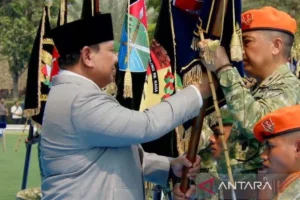
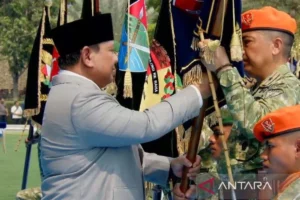
- Symbolic Commissioning of the Kodam Commanders: President Prabowo proceeded to formally inaugurate the leadership of the six newly established Regional Military Commands (Kodam). This was conducted symbolically through the handover of command batons and unit flags to the newly appointed Kodam commanders.
- Presentation of Unit Standards: The ceremony progressed with the presentation of new unit emblems and flags to seven designated representatives of the newly formed operational commands and battalions, symbolizing their official integration into the active operational structure of the TNI.
- Parade and Cultural Displays: The ceremony concluded with a massive military parade showcasing state-of-the-art defense machinery, infantry maneuvers, tactical vehicle roll-outs, and aerial acrobatics by the Indonesian Air Force, thrilling the attendees and dignitaries present at the headquarters.
Comprehensive Breakdown of Supporting Data and Unit Distribution
The expansion plan executed under President Prabowo’s administration addresses specific operational needs across the army, navy, and air force. A granular look at the data highlights the sheer scale of the 204 newly minted units:
1. Indonesian Army (TNI AD) Enhancements
As the largest branch, the Army absorbed the vast majority of the restructuring to optimize territorial control and border defense:
- Regional Commands (Kodam): Six new Kodam units were activated to decentralize command structures and improve regional security management.
- Territorial Development Brigades and Battalions: The establishment of 30 Territorial Development Infantry Brigades and 150 Territorial Development Infantry Battalions reflects a strategic shift toward community-integrated defense and localized stabilization.
- Combat Support (Banturl): Three specialized battalions were added to bolster firepower and defensive shielding:
- One Cavalry Battalion (mobile armored support).
- One Field Artillery Battalion (long-range fire support).
- One Air Defense Artillery Battalion (anti-aircraft and low-altitude missile defense).
2. Indonesian Navy (TNI AL) Enhancements
Recognizing Indonesia’s identity as an archipelagic nation, the Navy’s expeditionary arm received vital reinforcements:
- Marine Corps Growth: One new Marine Infantry Brigade and four Marine Infantry Battalions were activated. These units are critical for amphibious landings, coastal defense, and rapid deployment across maritime chokepoints and outer islands.
3. Indonesian Air Force (TNI AU) Enhancements
To safeguard the nation’s vast airspace, the Air Force scaled up its specialized rapid-response and surveillance capabilities:
- Pasgat (Kopasgat) Expansion: The establishment of the 2nd Parako Division, a Parako Brigade, and three Parako Battalions significantly increases the air force’s ground-based security and special operations footprint.
- Aviation and Surveillance: The activation of two new Air Squadrons boosts transport and tactical air support, while the two new Radar Units plug critical gaps in early-warning air surveillance networks. Additionally, a new Air Force Education Squadron was launched to handle advanced technical training for personnel.
Official Stances and Directives from the Leadership
Throughout the anniversary proceedings, President Prabowo Subianto used the platform to reiterate his vision for the military. He stressed that the strengthening of defense infrastructure must go hand-in-hand with ideological commitment to the populace.
In parallel statements delivered during the anniversary events, Prabowo emphasized the core identity of the armed forces, declaring that "the TNI must always remain a people’s army, deeply rooted in and close to the rakyat (people)." He noted that modern weaponry and organizational expansion are hollow without the trust, respect, and affection of the civilian population.
Furthermore, the President reminded the military corps of their ultimate constitutional burden. In a stirring address, Prabowo asserted:
"The honor of the nation and the welfare of the people rest squarely on the shoulders of the TNI."
Military leadership echoed these sentiments, noting that the formation of the 204 units is part of a long-term modernization roadmap. The integration of territorial units is specially designed to allow the military to work closely with local civil governments—such as regional communication forums (Forkopimko) and community initiatives—to foster localized stability, economic recovery, and disaster response preparedness, as seen in ongoing regional recovery efforts like those in Aceh by the Korem Lilawangsa.
Strategic Implications for Indonesia’s Defense and Geopolitics
The formal establishment of these 204 new military units carries profound implications for Indonesia’s domestic security posture and its standing within the Indo-Pacific geopolitical landscape.
Enhanced Territorial Command and Operational Agility
Historically, certain military commands oversaw massive geographical areas, stretching response times and administrative oversight. By introducing six new Kodam units and dozens of territorial infantry battalions, the TNI drastically reduces response latency. In times of natural disasters—frequent occurrences in Indonesia’s ring of fire—these units can act as immediate first responders, coordinating logistical relief, medical aid, and engineering support.
Deterrence and Power Projection
The naval and air force expansions—specifically the addition of Marine brigades and Air Force radar and air squadrons—directly address maritime security concerns in contested shipping lanes and exclusive economic zones (EEZs). Enhanced radar coverage provides better airspace and maritime domain awareness, while additional Marine and Pasgat battalions ensure that Indonesia retains a potent, credible deterrence posture against potential external aggression.
Socio-Economic Integration
By framing the new units as "Territorial Development" structures, the government is deliberately utilizing military infrastructure to support national development goals. These units are expected to collaborate with regional governments on infrastructure projects, agricultural support, and community resilience programs, effectively intertwining national defense with regional economic security.
As the 81st TNI Anniversary drew to a close, the newly commissioned commanders and troops stood ready to deploy to their respective assignments. The events of October 5, 2026, marked a defining chapter in Indonesia’s military evolution—signaling a resolute, forward-looking defense strategy designed to protect the sovereignty and prosperity of the republic for decades to come.