The Silent Crisis: How Kalimantan’s Wildfires Are Driving Pollinators into Exile
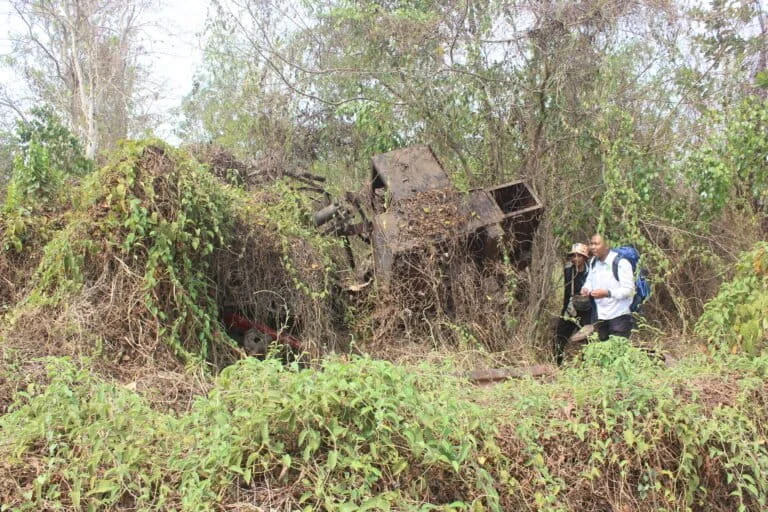
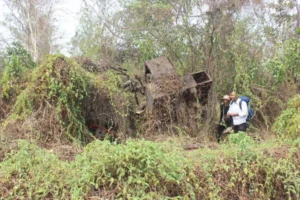
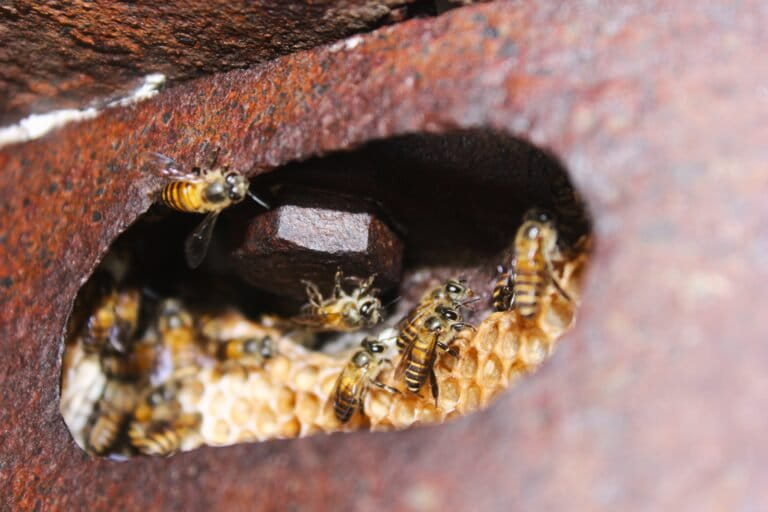
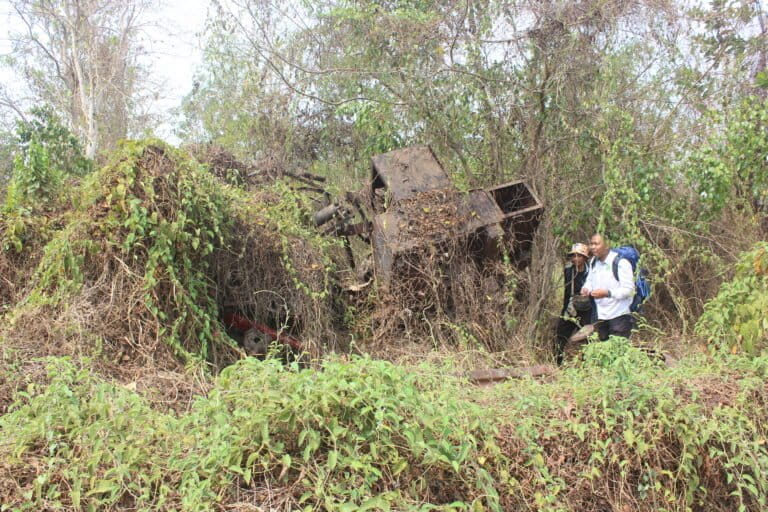
BANJARBARU, KALIMANTAN SELATAN – In the heart of the peatland landscapes of South Kalimantan, a strange and unsettling sight has emerged. Amidst the rusted, skeletal remains of heavy machinery abandoned in the scrublands of Liang Anggang, Banjarbaru, a resilient colony of Eastern honeybees (Apis cerana) has sought refuge. They have traded their ancestral homes—the towering, ancient trees of the Kalimantan rainforest—for the jagged, oxidized metal of industrial debris.
This is not a tale of adaptation; it is a desperate act of survival. As forest and land fires (karhutla) continue to ravage the province, the very fabric of the local ecosystem is unraveling, forcing one of nature’s most vital workers—the pollinator—into an uncertain and precarious exile.
The Scale of the Catastrophe
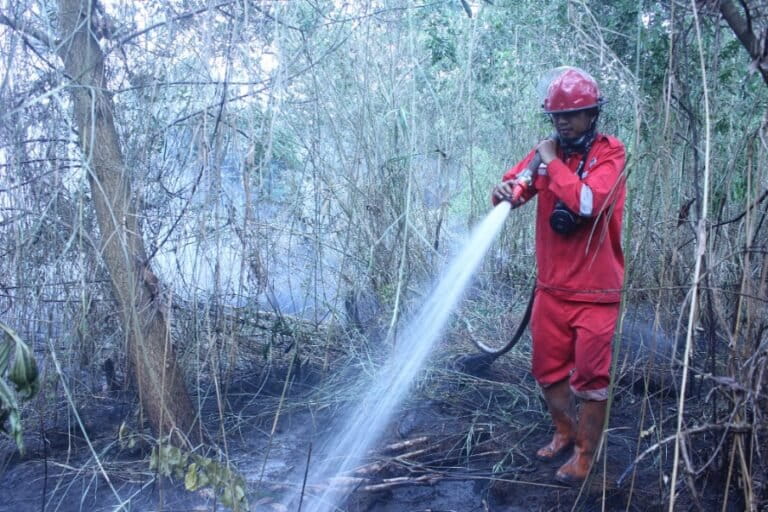
The statistics from the first three quarters of 2026 paint a grim portrait of environmental collapse. Between January 1 and October 14, 2026, the provincial disaster management agency (BPBD) of South Kalimantan recorded a staggering 4,926 incidents of forest and land fires. These infernos have scorched over 27,200 hectares of land, leaving behind a charred wasteland where once there was biodiversity.
The fires have not merely destroyed vegetation; they have decimated the micro-habitats upon which the region’s fauna depends. For the Apis cerana, a species roughly the size of an adult’s pinky fingernail, the destruction of their natural nesting sites—typically high-canopy trees—has forced them to relocate to atypical, often hazardous, environments.
Local resident Fauzan recalls that just months ago, these bees were thriving in trees roughly 50 meters to the west. "In the last three months, they have moved to places that make no sense," he says, gesturing toward the rusted, abandoned equipment now serving as a makeshift hive.
A Chronology of Environmental Distress
The timeline of this year’s fire season in South Kalimantan has been marked by record-breaking periods of drought. By early October, the province had endured nearly four months of relentless, arid conditions.
- Mid-2026: Initial reports of localized fires began to surface as the dry season took hold earlier than expected.
- August–September 2026: Fire intensity peaked. Observers noted that the habitual migration of bees, usually prompted by seasonal cycles, became frantic and disordered.
- Early October 2026: The situation reached a breaking point. Searchers for wild honey, such as Husni Naparin and Ismu from the Madu Hutan Kaum collective, began noticing that the flight paths of bees from main roads were no longer leading to forests, but to urban peripheries and scrap sites.
- October 14, 2026: Air quality in the province plummeted to "hazardous" levels, with PM2.5 concentrations peaking at 353.8 micrograms per cubic meter.
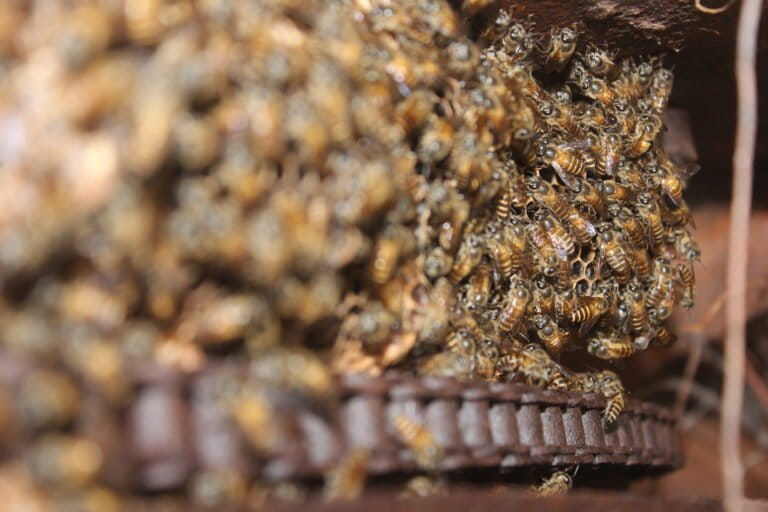
During their field observation, Naparin and Ismu carefully inspected the hive nestled within a rusted chain cover. "We saw layers of comb," Naparin noted. "It was quite large, filled with honey, but the bees were clearly stressed. They were actively moving, but the environment is devoid of the natural protection they need."
Supporting Data: The Drought and the Bees
The struggle of the Apis cerana is inextricably linked to the broader climatic failure currently gripping South Kalimantan. BMKG (the Meteorology, Climatology, and Geophysics Agency) has recorded extreme drought conditions across the province.
Ten major regions have gone without rain for over 60 days. Tamban, in the Barito Kuala Regency, leads this grim list with a staggering 118-day dry spell. Other regions, including Jorong, Pelaihari, and Panyipatan, have all surpassed 110 days without a single drop of rain.
This drought has created a "food desert" for pollinators. Honeybees rely on nectar-producing flowers, but the scorched earth has wiped out most floral resources. "The bees are forced to travel much further to find water and nectar," explains Ismu. "We are seeing many dead bees, and many of the old hives are now completely abandoned."
While the Apis cerana struggles, the larger Apis dorsata (giant honeybee) has been observed retreating to the Meratus Mountains. Over 100 kilometers from the capital, these bees are congregating on steep, rocky cliffs. Experts believe the higher elevation offers a cooler microclimate that helps the bees survive the heat and smoke, a luxury not available to those trapped in the lowlands.
Expert Perspectives: The Entomological View
Dr. Ramadhani Eka Putra, an entomologist from the Bandung Institute of Technology (ITB), emphasizes that the damage is two-fold. "The fires directly destroy the physical structures of the hives and the source of nectar—the flowers," he explains.
Beyond the loss of physical space, the smoke poses a significant physiological threat. "Smoke particles can contaminate the honey, but more importantly, it disrupts the bees’ navigation," Dr. Putra says. Bees rely on polarized light patterns in the sky to orient themselves. Heavy, thick smog—which has drifted as far as Malaysia and Singapore, triggering an ASEAN Alert Level 3—essentially blinds these insects, leaving them unable to find their way home.
The implications for agriculture are profound. Trisnu Satriadi, a researcher at the Faculty of Forestry, Universitas Lambung Mangkurat (ULM), warns that the loss of pollinators is a direct threat to food security.
"Pollinators are the backbone of agricultural productivity," says Satriadi. "If the bee population collapses, the rate of plant fertilization drops significantly. We are talking about lower crop yields for fruits, vegetables, and plantation commodities. If this continues, we aren’t just looking at an ecological crisis; we are looking at a future food crisis."
Official Responses and the Road Ahead
The government of South Kalimantan has officially declared a "State of Emergency" regarding the forest fires. However, calls from various civil society groups to elevate the situation to a "National Disaster" status have grown louder, citing the cross-border impact of the haze and the widespread destruction of local ecosystems.
BMKG officials provide a glimmer of hope, predicting that normal rainfall patterns may return by mid-November, with higher-than-average rainfall expected in December. Yet, experts like Satriadi remain cautious.
"Even if the rain comes, the habitat is destroyed," he notes. "The bees will not simply return. They will only come back when the vegetation has recovered and the source of food is restored. This is a long-term recovery, not a seasonal fix."
For now, the honey hunters have made a choice: they are leaving the hives alone. "We decided not to harvest," says Naparin, carefully covering the rusted chain-case. "We want them to survive so that when the rains finally come, the remaining colonies have a chance to multiply."
Conclusion: A Warning from the Hive
The image of a honeybee colony clinging to a rusted, toxic scrap of metal in a fire-ravaged landscape is a poignant symbol of the Anthropocene. It is a reminder that nature is not merely a backdrop to human activity; it is a complex, fragile web of dependencies. As South Kalimantan struggles to contain the flames, the plight of the bees serves as a clarion call. If we continue to allow our forests to burn, we are not just losing timber and land—we are losing the essential architects of our food supply and the delicate, buzzing vitality of the natural world.
The question remains whether the policy response will be as resilient and adaptive as the creatures they are failing to protect. Until the smoke clears and the rains return, the bees of Banjarbaru remain in limbo, waiting for a forest that is currently nothing more than ash.