Echoes of 1928: The Historical Evolution, Legacy, and Enduring Impact of Indonesia’s Youth Pledge (Sumpah Pemuda)
Every year on the 28th of October, the Republic of Indonesia comes to a virtual standstill of reflection and celebration to commemorate Hari Sumpah Pemuda (Youth Pledge Day). Far beyond a routine historical entry on a school calendar, this date marks the ideological genesis of the Indonesian nation-state. Long before the historic proclamation of independence on August 17, 1945, a coalition of fragmented, regionalist youth organizations gathered in Batavia (now Jakarta) to forge a singular national identity.
The story of the Sumpah Pemuda is not merely a tale of political maneuvering; it is a dramatic narrative characterized by fierce colonial surveillance, clandestine musical performances, cross-cultural solidarity, and the birth of a unified national consciousness.
Main Facts: The Anatomy of a National Awakening
At its core, the Sumpah Pemuda refers to the historic oath sworn by young nationalists during the closing moments of the Second Youth Congress (Kongres Pemuda II) on October 28, 1928. The core tenets of this oath, written originally in the Van Ophuijsen spelling system of Malay, established three foundational pillars for a future Indonesia: one motherland, one nation, and one unifying language.

+-------------------------------------------------------------------+
|                     THE TEXT OF SUMPAH PEMUDA                     |
+-------------------------------------------------------------------+
| 1. Pertama: Kami poetra dan poetri Indonesia, mendjandji           |
|    tanah air jang satoe, tanah air Indonesia.                     |
|    (First: We, the sons and daughters of Indonesia, acknowledge   |
|    one motherland, the land of Indonesia.)                        |
|                                                                   |
| 2. Kedoea: Kami poetra dan poetri Indonesia, mendjandji            |
|    bangsa jang satoe, bangsa Indonesia.                           |
|    (Second: We, the sons and daughters of Indonesia, acknowledge  |
|    one nation, the nation of Indonesia.)                          |
|                                                                   |
| 3. Ketiga: Kami poetra dan poetri Indonesia, mendjendji            |
|    menjendjoeng bahasa persatoean, bahasa Indonesia.              |
|    (Third: We, the sons and daughters of Indonesia, uphold the    |
|    language of unity, the Indonesian language.)                   |
+-------------------------------------------------------------------+
Key Stakeholders and Demographics
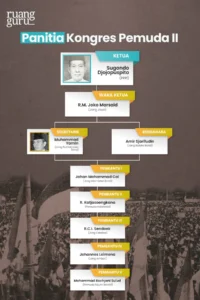
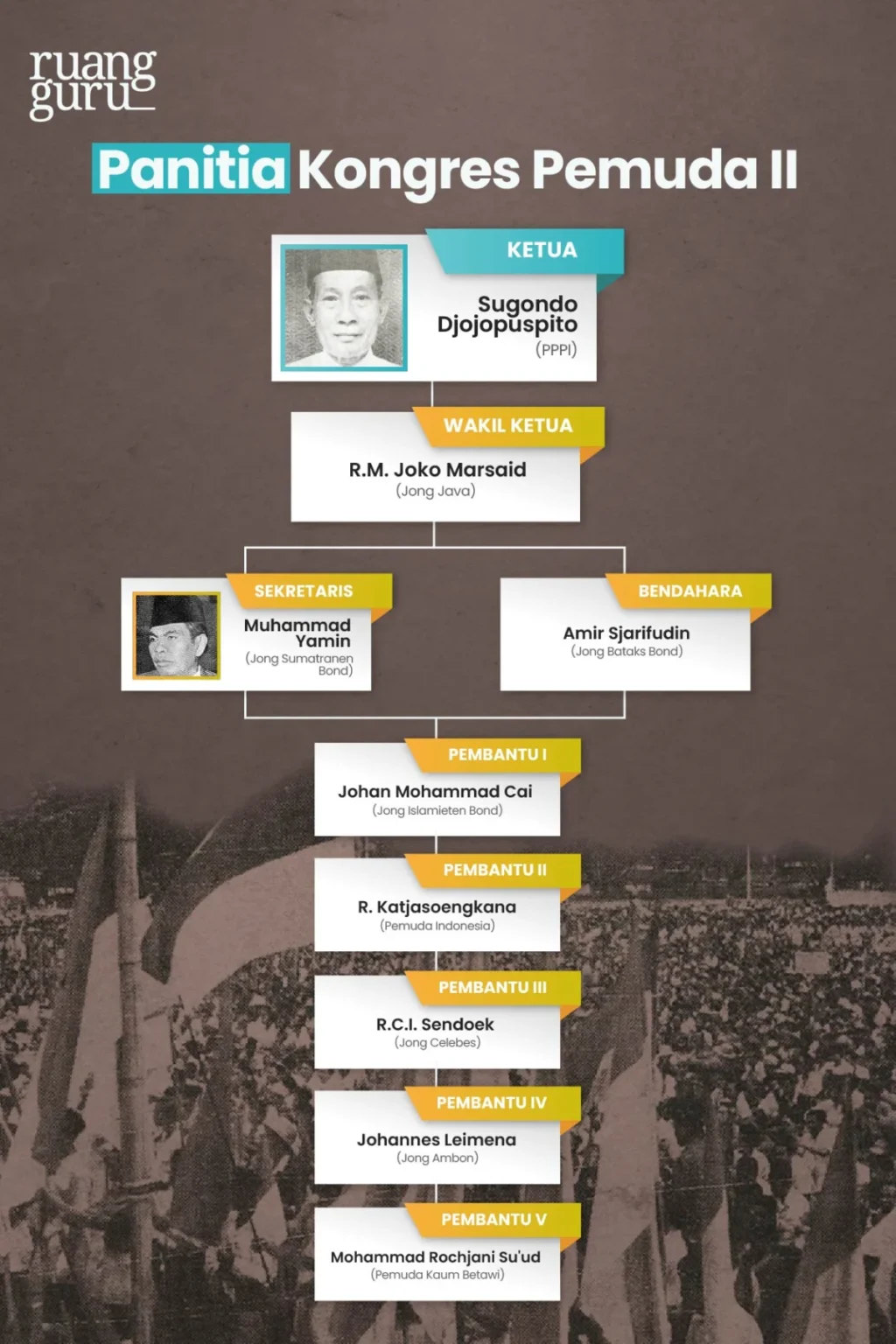
The congress was historic not only for what it achieved, but for who achieved it. Unlike earlier resistance movements that fractured along ethnic, religious, and regional lines, the Second Youth Congress was an unprecedented melting pot.
- Diverse Youth Associations: Attendees included representatives from Jong Java, Jong Bataks Bond, Jong Islamieten Bond, Jong Celebes, Jong Sumatranen Bond, Jong Ambon, Katholieke Jongelingen Bond, Pemuda Kaum Betawi, and Sekar Rukun.
- Ethno-Cultural Inclusivity: Notably, the congress saw active participation from ethnic Chinese-Indonesian youths—such as Kwee Thiam Hiong (a member of Jong Sumatranen Bond), Oey Kay Siang, John Lauw Tjoan Hok, and Tjio Djien Kwie—proving that the concept of "Indonesia" transcended indigenous ethnic boundaries.
- The Venue: The iconic boarding house owned by Sie Kok Liong, located at Jalan Kramat Raya 106 in Central Jakarta, served as the crucible for these negotiations and is preserved today as the Sumpah Pemuda Museum.
Chronology: From Regional Division to National Unity
To understand how the Sumpah Pemuda came to fruition, historians trace the movement through two distinct national congresses that exposed the growing pains of anti-colonial resistance in the Dutch East Indies.
1. The First Youth Congress (April 30 – May 2, 1926)
Conened in Jakarta, the First Youth Congress was the initial attempt to bring together disparate youth factions. However, participants were still heavily shackled by strong parochial and regional sentiments. Discussions were bogged down by loyalty to specific islands or ancestral cultures rather than a collective national vision. Despite these limitations, the congress yielded a vital organizational stepping stone: the establishment of the Association of Indonesian Students (Persatuan Pelajar-Pelajar Indonesia or PPPI). The PPPI was designed explicitly to break down regional barriers, serving as the ideological spark that would fuel the subsequent congress.

2. The Second Youth Congress (October 27–28, 1928)
Spread across multiple locations in Batavia, the Second Youth Congress was structured into three distinct sessions to bypass colonial suspicion while systematically building momentum:
- Session 1 (October 27 at Katholieke Jongelingen Bond Building): Focused on the importance of unity, national history, and the role of education in binding the archipelago together.
- Session 2 (October 28 at Oostkjava Bioscoop): Addressed educational philosophies and the cultivation of national character.
- Session 3 (October 28 at the Kramat Raya 106 Building): The climax of the congress, where the historic oath was formulated and the national anthem was played for the first time.
Supporting Data and Dramatic Turning Points
The birth of the Sumpah Pemuda was accompanied by high-stakes drama, political intrigue, and cultural milestones that permanently altered the trajectory of the Indonesian freedom struggle.
The Midnight Drafting of the Pledge
As the congress neared its conclusion on October 28, 1928, there was initially no formal agenda to issue an overarching oath. Sensing the historic weight of the gathering, Mohammad Yamin—a prominent youth leader and intellectual—scribbled a draft on a small piece of paper. He passed it to the congress chairman, Soegondo Djojopoespito, alongside a whispered phrase in Dutch: "Ik heb een eleganter formulering voor de resolutie" ("I have a more elegant formulation for the resolution").

Soegondo approved the text, and it was circulated among the delegates. Enthusiastically endorsed, Yamin’s text became the three-point pledge. Initially referred to simply as the Ikrar Pemuda (Youth Pledge), it was later codified as the Sumpah Pemuda.
The Clandestine Debut of "Indonesia Raya"
Perhaps the most enduring cultural legend of the congress was the clandestine premiere of the national anthem, "Indonesia Raya," composed by Wage Rudolf Supratman (W.R. Supratman).
Under the watchful, suspicious eyes of Dutch colonial intelligence agents—who closely monitored nationalist gatherings and outlawed inflammatory rhetoric—singing a song containing the words "Freedom" (Merdeka) or "Indonesia" could lead to immediate arrest or the violent dissolution of the congress.

During an intermission, W.R. Supratman performed the melody on his violin without lyrics to test the waters. The haunting, powerful strains of the violin captivated the audience, who demanded an encore.
To circumvent colonial surveillance while honoring the crowd’s emotional response, organizers agreed to let a vocalist sing the anthem with a clever linguistic modification: the politically explosive word "merdeka" was temporarily swapped with "mulia" (noble).
The honor of being the inaugural vocalist fell to a 15-year-old girl named Theodora Atia—better known as Dolly Salim, the brilliant daughter of National Hero Haji Agus Salim. Standing on a chair in the front row of the crowded, stage-less room, Dolly sang out, accompanied softly by the piano. Every delegate in the room rose to their feet. In that singular moment, the psychological barrier of colonial oppression was shattered.

Implications: The Legacy of the Youth Pledge
The ramifications of the October 28, 1928 congress resonated across decades, laying down structural pillars that define modern Indonesia to this day.
1. Linguistic Democracy and National Identity
By selecting Malay—then a lingua franca used for trade across the archipelago—and elevating it to the status of Bahasa Indonesia (the Indonesian language), the youth achieved a masterstroke of nation-building. Unlike many post-colonial nations that inherited the language of their oppressors as their official tongue, Indonesia united under an indigenous, egalitarian medium. This ensured that no single dominant ethnic group (such as the Javanese, despite their demographic majority) could culturally colonize the others.
2. Redefining "Pemuda" (Youth) in the National Narrative
A common linguistic trivia regarding the term Sumpah Pemuda clarifies its inclusive nature. In English, the movement is appropriately termed the Youth Oath (derived from the gender-neutral youth). The congress demonstrated that the fight for freedom was not restricted by gender; figures like Dolly Salim, Emma Purwodihardjo, and other female delegates played foundational roles. The "youth" of 1928 were defined not by gender or age demographics alone, but by a radical, forward-thinking mindset dedicated to overthrowing feudalism and colonialism.

3. A Permanent Antidote to Sectarianism
In contemporary Indonesia, the Sumpah Pemuda serves as an ideological anchor against religious extremism, ethnic tribalism, and separatism. The phrase "Bhinneka Tunggal Ika" (Unity in Diversity), later adopted as the national motto, finds its practical blueprint in the events of the Second Youth Congress. Whenever modern social fractures threaten national harmony, the historical precedent of 1928 is invoked to remind citizens that their collective strength lies in their shared destiny, not their segmented origins.
Official Responses and Historical Reflection
In the decades following the declaration, successive Indonesian governments have institutionalized the memory of October 28. Through presidential decrees and educational curricula, Hari Sumpah Pemuda is commemorated nationwide through flag ceremonies, cultural exhibitions, and youth forums.
Historians and sociologists frequently emphasize that the true genius of the Sumpah Pemuda lies in its voluntary nature. It was not imposed from above by an authoritarian ruler or a colonial master; rather, it bubbled up organically from the grassroots—from students, intellectuals, artists, and activists who chose to look past their differences and write a shared future into existence. As contemporary Indonesia navigates the complexities of the 21st century, the timeless challenge issued at Kramat Raya 106 remains clear: to honor the pledge of unity, protect the language of the nation, and defend the integrity of a diverse motherland.