Calculated Ambition: Why Moto3 Prodigy Hakim Danish is Prioritizing Mastery Over Rapid Promotion
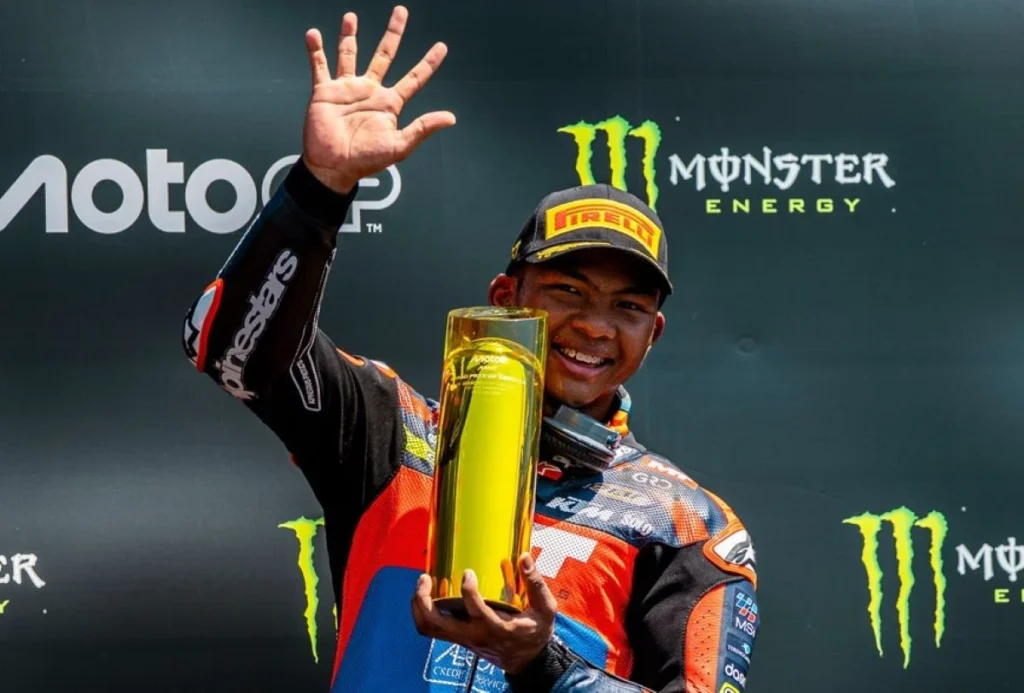
KUALA LUMPUR – In the high-octane world of Grand Prix motorcycle racing, the allure of the intermediate class, Moto2, is often a siren song that young riders find impossible to resist. However, Malaysian rising star Hakim Danish has chosen a different path. The 18-year-old sensation, currently competing in the Moto3 World Championship with the Aeon Credit-MT Helmets-MSI team, has officially confirmed that he will decline several offers to move up the ladder next season, opting instead to commit to another year of development in the lightweight class.
In an era where "fast-tracking" talent is the industry standard, Danish’s decision is a masterclass in patience and strategic career management. His choice reflects a mature understanding of the technical demands required to succeed at the world level, prioritizing long-term sustainability over short-term prestige.
1. The Decision: A Strategic Pause in a Fast-Paced Career
For a rider of Danish’s caliber, the transition to Moto2 is often viewed as the natural progression. With multiple teams knocking on his door, the temptation to jump onto a more powerful Triumph-engined machine is palpable. Yet, speaking to Berita Harian this past Wednesday, the teenager made his position clear: the transition to Moto2 is a leap he is not yet prepared to take.
"I want to increase my knowledge in Moto3. If I go to Moto2, the competition is indeed more challenging, so I need to think maturely before making that decision," Danish stated. This is not a confession of inadequacy, but rather a cold, calculated assessment of his own development curve.
Danish acknowledges that while his raw speed has earned him a seat in the paddock, the nuances of Moto2—a class defined by heavier frames, higher torque, and a vastly different riding style—require a foundation that he believes is still being refined in the cut-and-thrust environment of Moto3.
2. Chronology of a Rising Star: From Asia to the World Stage
To understand why Danish is such a sought-after commodity, one must look at his meteoric rise through the racing ranks.
- The Early Years: Danish first made waves in the Asia Talent Cup, where his aggressive riding style and innate ability to manage tire degradation marked him as a future prospect for the Malaysian motorsport scene.
- The Junior World Championship Era: Moving into the FIM JuniorGP World Championship, he consistently ran at the front, proving that he could handle the pressure of European circuits—a hurdle that has ended the careers of many Asian prospects.
- The Moto3 Call-Up: His performance in the junior ranks earned him a permanent seat with the Aeon Credit-MT Helmets-MSI squad. Since his debut, he has been a consistent presence in the points, demonstrating a level of race craft that belies his young age.
- The 2026 Season Crossroads: The current 2026 season has been his most critical. As teams began scouting for the 2027 grid, Danish found himself at the center of a transfer tug-of-war. By choosing to stay put, he has effectively silenced rumors of an premature exit, signaling to the paddock that he is a rider who dictates his own timeline.
3. Technical Demands: Why Moto2 is a Different Beast
Danish’s caution is backed by the technical reality of Grand Prix racing. The jump from a Moto3 machine (typically a 250cc single-cylinder bike) to a Moto2 machine (a 765cc triple-cylinder prototype) is significant.
The Torque Challenge
Moto2 bikes produce significantly more torque. Unlike the Moto3 bikes, which require riders to carry extreme corner speed to keep the momentum alive, Moto2 machines demand precise throttle management to handle the sudden surge of power upon exit. Danish recognizes that mastering this power delivery is the difference between a mid-pack finish and a podium contender.
The Aerodynamic and Physical Burden
Moto2 bikes are heavier and physically more demanding. The forces exerted on a rider’s body during braking and high-speed cornering are exponentially higher. Danish’s training regime, which he often highlights on his social media platforms, is intense, but he believes that another year of building physical resilience in the Moto3 class will serve him better than rushing into a bike he isn’t fully conditioned to tame.
The "Density of Competition"
The Moto2 grid is notorious for its pack-racing intensity. Unlike the premier class (MotoGP), where individual bike performance can sometimes mask rider errors, Moto2 is a category where the field is separated by mere hundredths of a second. Danish’s desire to "understand more about racing" suggests he is studying how to navigate these tight packs more efficiently, rather than simply relying on top-end speed.
4. Official Perspectives and Team Dynamics
The management at Aeon Credit-MT Helmets-MSI has been supportive of their rider’s decision. In professional racing, a team’s primary objective is to develop a rider into a championship winner. By allowing Danish to stay, the team is investing in a potential title contender for the 2027 Moto3 season, rather than a "rookie year" struggle in the Moto2 mid-field.

"Hakim is a rider who thinks," says a team source. "Many riders feel the pressure to move up simply because their peers are doing it. Hakim is different. He listens to his team, he analyzes his telemetry, and he understands his own limits. That maturity is what will make him a champion eventually."
For the Malaysian fans, this news might come as a slight disappointment—as the nation waits for its next hero to dominate the intermediate class—but it is also a point of pride. Having a rider who refuses to settle for being "just another entry" on the grid is a testament to the growth of the Malaysian motorsport ecosystem.
5. The Broader Implications: A Shift in Rider Mentality?
Danish’s decision may represent a broader shift in how young talent approaches their career trajectories. For years, the "Moto3 to Moto2 to MotoGP" pipeline was treated as a conveyor belt. If you didn’t move up within two years, you were considered "stagnant."
However, recent trends in the paddock—marked by the rising age of elite riders and the increasing technical complexity of the machinery—suggest that "rushed promotion" is a dangerous gamble. Riders like Dani Pedrosa and Marc Marquez had different paths, but both underscored the importance of mastering the machine beneath them before moving to the next level of complexity.
The Value of "Mastery"
By staying in Moto3, Danish is effectively choosing to dominate rather than survive. If he can secure a top-three finish in the standings next year, he will enter the Moto2 paddock not as a "promising rookie," but as a "proven winner." This status carries significant weight in contract negotiations and team selection.
Economic and Sporting Sustainability
Furthermore, staying in a familiar environment provides psychological stability. The Moto3 paddock is a high-pressure, high-stress environment. By staying with a team he trusts, Danish can focus entirely on his craft without the distraction of learning new engineering team dynamics or team structures.
6. Looking Toward the Future
As the 2026 season enters its final stages, the focus for Hakim Danish remains squarely on the track. His goal for the remainder of the year is simple: to refine his race-craft, minimize unforced errors, and build the physical and mental stamina required for the 2027 campaign.
He is not just racing for points; he is racing for his future. By rejecting the siren call of Moto2, he has proven that he is the architect of his own career. He understands that in the world of Grand Prix racing, you only get one chance to make a first impression in a new category. Hakim Danish intends to make sure that when he eventually arrives in Moto2, he does so with the intent to win, not just to participate.
The path to the MotoGP World Championship is long and filled with attrition. For the 18-year-old from Malaysia, it is a marathon, not a sprint. And for now, he is perfectly content to pace himself, ensuring that when the time comes for the big move, he is more than ready to leave his mark on the history books.
Summary of Key Takeaways:
- Maturity: Hakim Danish prioritizes long-term development over immediate career advancement.
- Technical Awareness: The rider acknowledges the specific challenges of Moto2’s power and weight.
- Team Support: His decision is backed by his team, Aeon Credit-MT Helmets-MSI, favoring a championship-contention strategy for 2027.
- Strategic Growth: The decision highlights a growing trend of riders choosing "mastery" over the industry’s "fast-track" mentality.