Bridging the Talent Gap: How the ‘MagangHub’ Initiative is Redefining Workforce Integration in Indonesia
Bekasi, West Java – In an era defined by rapid technological shifts and evolving industry demands, the perennial challenge of the "skills mismatch" remains a critical hurdle for developing economies. Indonesia, through the Ministry of Manpower (Kemnaker), is taking a proactive stance to bridge this divide. Minister of Manpower Yassierli recently underscored the pivotal role of the "MagangHub" (National Internship Program) as a transformative mechanism that shifts recruitment from a transactional process to a strategic, competency-based acquisition model.
During a site visit to PT Adyawinsa Electrical and Power (AEP) in Bekasi on Tuesday, July 21, 2026, Minister Yassierli highlighted that the program is no longer just an educational formality; it has evolved into a cornerstone of industrial talent strategy.
The Strategic Vision: Beyond Traditional Recruitment
For years, the recruitment process for fresh graduates in Indonesia has often been hindered by a lack of practical experience, leaving firms hesitant to invest in unproven talent. The MagangHub initiative seeks to dismantle this barrier by integrating recruitment directly into the training lifecycle.
"The National Internship Program offers a concrete, dual-benefit value proposition," Minister Yassierli stated during his inspection of PT AEP’s operational floor. "It allows companies the time and space to mentor, accompany, and rigorously assess a candidate’s competency, work ethic, and cultural fit before committing to permanent employment."
By embedding the evaluation process within the actual workflow of the company, MagangHub facilitates what the Minister describes as "talent acquisition that is far more effective than traditional interview-based hiring." Instead of relying on snapshots of a candidate’s background, companies gain a high-definition view of a worker’s real-time performance and problem-solving abilities.
Chronology of the Visit: A Case Study in Success
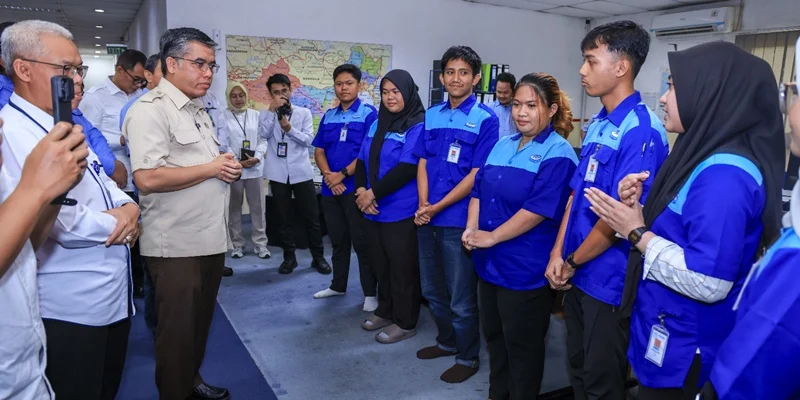
The visit to PT Adyawinsa Electrical and Power served as a showcase for the program’s efficacy. During the session, Minister Yassierli, accompanied by Ministry officials—including Secretary-General Cris Kuntadi and Director General of Vocational Training and Productivity Darmawansyah—met with eight alumni of the MagangHub program.
These eight individuals, all of whom transitioned from interns to full-time employees at PT AEP, provided anecdotal evidence of the program’s success. For the company, they represented a "de-risked" investment; for the employees, the program provided a bridge from academic theory to the high-stakes environment of a manufacturing and energy solutions firm.
.jpeg)
Administration Director of PT AEP, Ign. Ilham Chrisbijantoro, confirmed that the firm has integrated MagangHub into its human resources strategy, noting that the graduates who participated in the internship were already fully operational and acclimated to the company’s standards upon signing their employment contracts.
Supporting Data: The Mechanics of ‘Link and Match’
The success of MagangHub lies in its adherence to the "Link and Match" philosophy—a government mandate designed to harmonize the output of Indonesia’s higher education institutions with the specific needs of the industrial sector.
Why the Current Model Works:
- Risk Mitigation for Employers: Companies eliminate the "probationary gamble." By the time a hiring decision is made, the employer has observed the candidate under actual operational stress.
- Competency Calibration: Interns are not merely observers; they are active participants in the production or service cycle. This ensures that their skills remain relevant to the latest industrial machinery and management software.
- Work Ethic Development: Beyond technical skills, the program emphasizes soft skills—punctuality, collaboration, and professional integrity—which are often cited by Indonesian industry leaders as the primary gaps in fresh graduates.
- Economic Efficiency: By reducing turnover and onboarding costs, companies can reallocate resources toward research and development or expansion, fueling overall economic productivity.
Official Responses and Policy Alignment
Minister Yassierli emphasized that this program is a cornerstone of the national agenda, receiving direct support from the President of the Republic of Indonesia.
"The President has mandated this as a national priority because we recognize that the quality of our human resources is the primary determinant of our future as a global economy," Yassierli remarked. "This is not just about helping people find jobs; it is about creating an adaptive workforce that can keep pace with Industry 4.0 and beyond."
The Ministry of Manpower (Kemnaker) is currently focused on scaling these partnerships. By creating a unified digital portal through the MagangHub platform, the government is lowering the administrative burden for companies, allowing even Small and Medium Enterprises (SMEs) to access a pool of high-quality, vetted talent.
Implications: A New Era for the Indonesian Workforce
The ripple effects of a successful MagangHub program are significant, spanning social, economic, and institutional dimensions.
Implications for Graduates
For the millions of young Indonesians entering the workforce annually, the program provides a critical pathway to gain "experience before employment." It mitigates the common frustration of being rejected for a lack of experience, effectively providing a structured environment where experience is earned rather than required at the gate.

Implications for the Industry
Industries in Indonesia, particularly in the manufacturing and technical sectors, have long struggled with high costs associated with training new hires from scratch. MagangHub shifts this burden toward a collaborative model where the government supports the framework, while the industry provides the practical arena. This leads to a more agile, high-productivity workforce that can compete globally.
Institutional Synergies
The program necessitates a closer relationship between the Ministry of Education, the Ministry of Manpower, and private sector players. This "triple-helix" model (Government-Industry-Academia) is essential for a country aiming to escape the middle-income trap. If the curriculum in universities can be dynamically adjusted based on the feedback from internship placements, the entire education system becomes more responsive to market forces.
Looking Ahead: The Path to Expansion
As the Ministry of Manpower continues to advocate for broader participation, the future of the MagangHub program rests on three pillars: Scale, Quality, and Sustainability.
- Scaling Participation: The Ministry aims to onboard a diverse array of sectors, moving beyond manufacturing to include digital services, green energy, and the creative economy.
- Maintaining Quality: Strict monitoring of internship standards is necessary to ensure that companies use the program for genuine training rather than as a source of low-cost labor. The Ministry has signaled that it will implement robust evaluation metrics for host companies.
- Sustainability: The ultimate goal is for the MagangHub ecosystem to become self-sustaining, where companies view internship programs not as a corporate social responsibility (CSR) obligation, but as a standard, indispensable component of their annual talent acquisition strategy.
In closing, Minister Yassierli reiterated that the collaboration with companies like PT Adyawinsa Electrical and Power is a blueprint for the future. "We are building a bridge," he said. "On one side, we have the ambition and energy of our youth. On the other, we have the immense potential of our industries. MagangHub is the structure that connects them, ensuring that the progress of one becomes the progress of all."
As Indonesia continues its trajectory toward becoming one of the world’s top economies, the integration of workforce training and real-world employment will remain the definitive metric of its success. Through initiatives like MagangHub, the government is demonstrating that it is not merely reacting to the needs of the market, but actively architecting the next generation of the Indonesian workforce.